Mikono · Built in Kampala
Know where to go.
A phone app for your sales reps and one back office for stock, sales, finance and customers, built for distributors in East Africa.
The problem
You find out how the day went after it is over.
The trucks leave at seven. At six you get a receipt book, a phone call or a WhatsApp photo of a page. If a stop went wrong at half past nine, you hear about it after the shop has closed.
How it works
The rep enters each stop once.
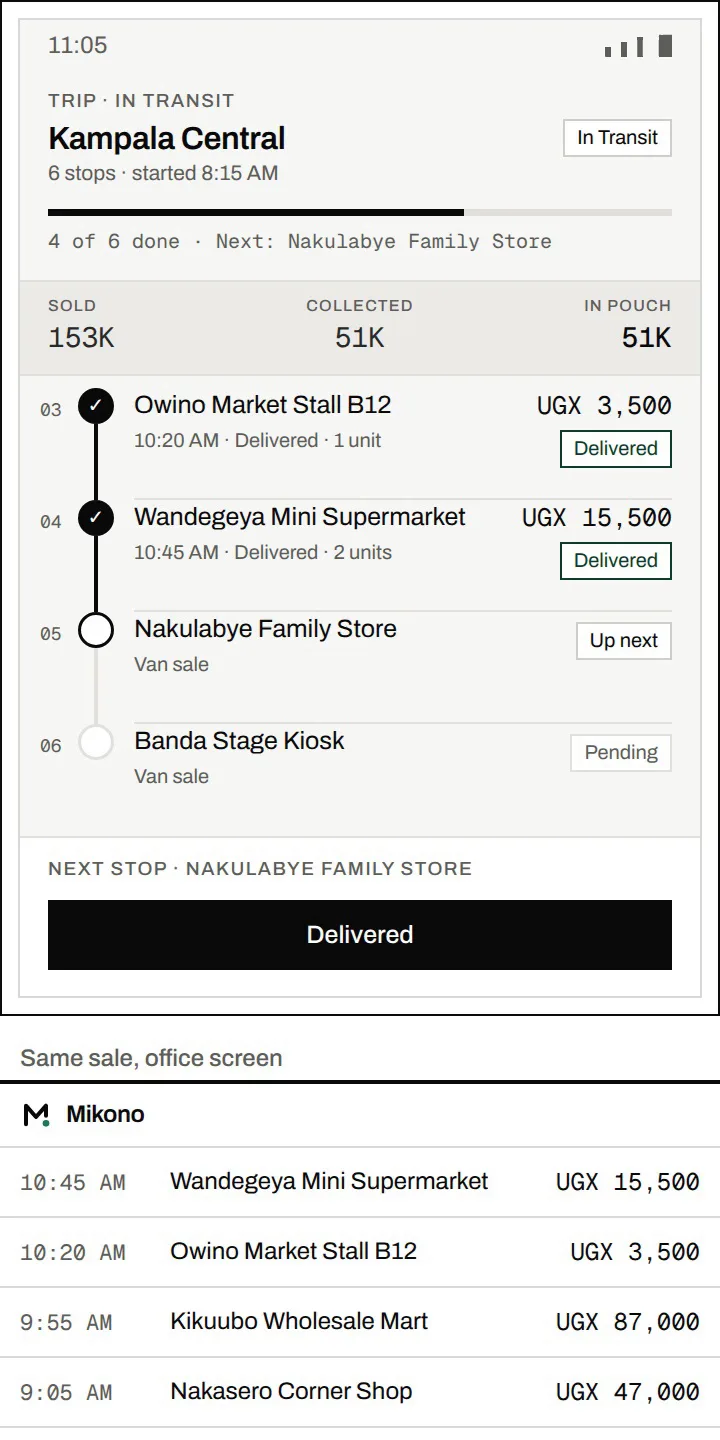
When the rep marks a stop delivered, the invoice, the stock and the cash are recorded together. Nothing is typed up in the evening.
The phone works all day without network and sends the stops when it finds a signal. In the office, every rep’s day is on one map: the outlets visited and missed, how many visits sold, and who is falling behind.
In the shop
The rep walks in knowing what to sell.
When the rep opens a shop on the phone, Mikono says whether it is buying as often as it usually does and what to do about it, and lists its last orders and what is still owed. Below that: what it usually buys, what it has stopped taking, and the best sellers it has never ordered. The rep starts the sale from that list and notes what the competition is doing on the shelf.
How the work flows
From the principal to the shop, and back to your office.
Your principal’s system sends the products, prices and routes. You load the truck. Your rep sells in the shop. What happens at the counter is back in your office the same day.
- To the shop: products, prices, the route and the load
- Back to the office: the sale and the cash, the same day
- From the principal’s system, when it is connected
Brand owner
Principal
Products · prices · routes
From the principal’s system to the distributor: Principal’s systemProducts · prices · routes
Depot and office
Distributor
Loads the truck · settles the day
Distributor to rep: Truck loaded · 6 stopsKampala Central
Rep to distributor: In the office · 11:05Nakulabye Family StoreUGX 32,000
Mikono Go
Rep
Sells · collects cash
Rep to shop: Van sale · 3 linesSoda, juice, water
Shop to rep: Paid cashUGX 32,000
The counter
Shop
Orders · pays · owes
What changes
Three things you know by four o’clock.
UGX 51,000
in the rep’s pouch · one trip
How much cash each rep is carrying.
Every payment is recorded at the stop, cash and mobile money apart. At the end of the trip the count is checked against what the rep hands in.
Trip screen and trip settlement
13
visits overdue · last 28 days
Which shops nobody has visited.
Every shop past its visit date, and every shop never visited, with the rep and the truck responsible.
Planning screen
Same day
credit on the customer’s account
Who owes you, right now.
A credit sale goes onto the customer’s account at the stop, not on Friday. Your accountant sees the same figure.
Trip settlement and the customer page
Who it is for.
Distributors and field sales teams
Reps run the route from the phone. Stops, sales, cash and credit are recorded in the shop.
Relationship and customer-service teams
Customers are found by phone number, because most have no email. New leads are matched to existing customers as the number is typed. Each complaint gets a 14-day deadline, and the team can see which ones are running late.
Behind both: stock, sales, purchasing and finance in one system.
Connections
Works with the systems you already use.
QuickBooks Online
Sales, receipts, collections and credit notes post to QuickBooks as they happen. Your accounts stay in QuickBooks.
URA EFRIS
Each sale goes to URA as a fiscal invoice. Once URA accepts it, the printed receipt carries the fiscal number and QR code. Credit notes go to URA for approval.
WhatsApp
Shops order on your own WhatsApp number, by text or voice note. Mikono reads the order, asks the shop to confirm it, and tells them when it is on the truck and when it is delivered.
Distributor management systems
Outlets, products, prices, routes and sales come in from your principal’s system. Mikono takes each record in and tells the principal’s system which ones it could not accept, and why.
For anything else, Mikono has a REST API with a sandbox to test in. Your IT team or integrator can read and write records and get a webhook when one changes.
Know where to go.
Fifteen minutes on a call, with one of your routes on the screen.